Folded edges
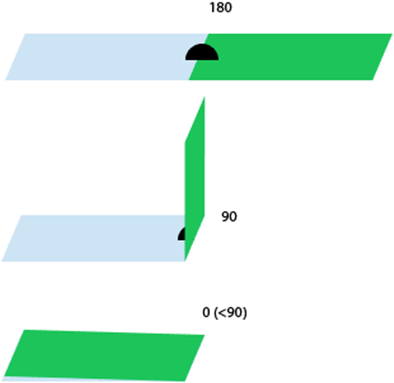
Measurement principle for the angle between adjacent triangles. click to enlarge
The objects contained in the 3D mesh structural model are tri-mesh surfaces. These surfaces should not have sharp kinks, such geometric complexities may prevent your model from being meshed. Also, local kinks or sharp bends in a tri-mesh may lead to issues when extending and/or retracting your tri-meshes.
To review the geometry of the tri-meshes and to avoid any processing issues you review the geometry of your tri-meshes in respect to sharp bends with the Folded edges test. You specify a maximum angle between two adjacent triangles of a tri-mesh; all angles below this value will be considered 'folded edge'. A completely flat tri-mesh would have angles of 180°, a right angle is 90° and a tri-mesh folded onto itself would show angles of 0°. Triangles in tri-meshes in your fault model should not have angles below 90° and stay well above this value.
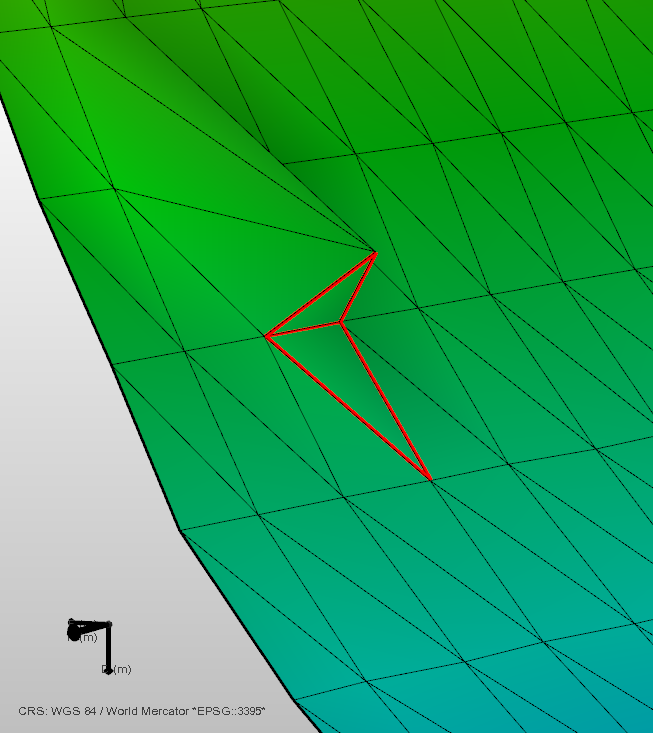
Example of a folded edge. A local angle around 85° is detected in this example. The two triangles that are creating a folded edge are highlighted in red in the Diagnostic View. click to enlarge
Not all folded triangles lead to processing artifacts. In the context of the 3D mesh structural modeling workflow you should try to remove any folded triangles to reduce the chances of introducing artifacts. The folded triangles can be introduced at different steps in the workflow:
- Folded triangles may enter the workflow by being present in the input data sets. Review the processing steps of these tri-meshes, e.g. interpolation steps of polygons.
- The resampling of faults in the Assign Data step in an earlier run of the Fault Modeling workflow may introduce, in rare cases, folded triangles. Other than changing the modeling parameters or choosing not to resample, you can edit the input tri-meshes or the fault tri-meshes in the fault model with the editing tools. You can also edit the tri-meshes directly in the 3D mesh structural model. Examples on how to do this are given below.
Solving the issue using the editing tools
To manually remove a folded edge situation you can use a variety of editing tools on the tri-mesh.
- If the folded edge is only caused at a single location leading to a local spike, you can smooth the surface by just interacting with a single node. Use the Move Node tool
 to move the node into the desired location, or remove the node altogether by using the Remove Node
  tool. The latter will collapse the node and reconnect the triangle connections.
 - Other options are in some cases to flip the triangle’s edges (Flip Triangle Edge
 ).
). - For larger affected areas, you can also delete one or more triangles and fill the gap with the Fill Hole
 tool as shown below.
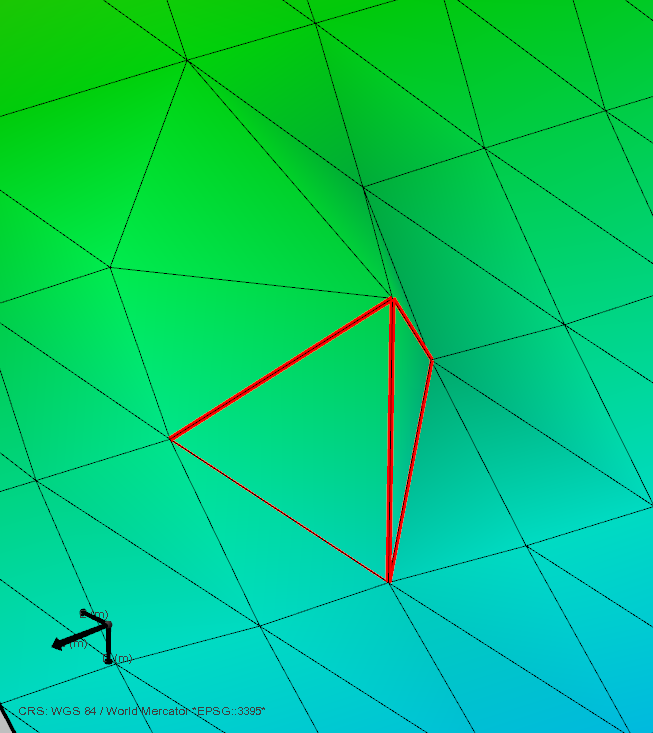
The two triangles that are creating a folded edge are highlighted in red in the Diagnostic View. click to enlarge
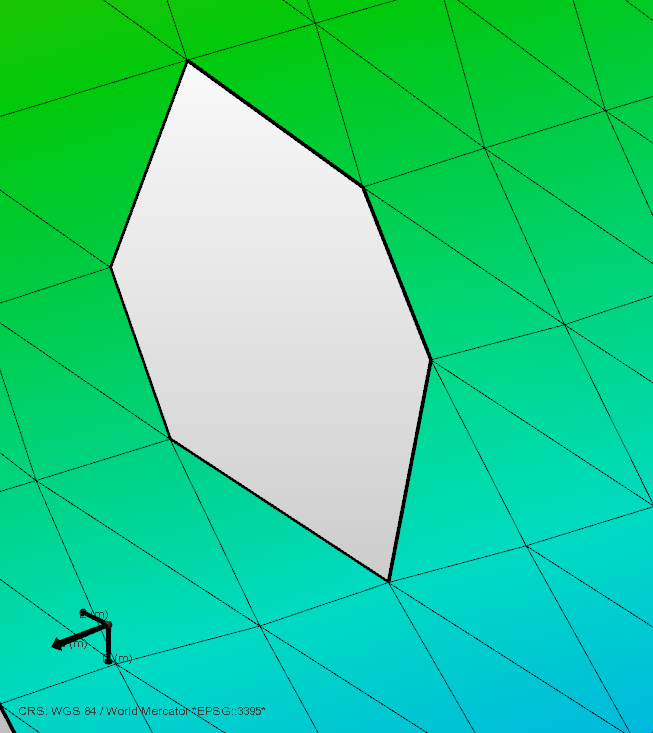
The local spike is removed by deleting the surrounding triangles. click to enlarge
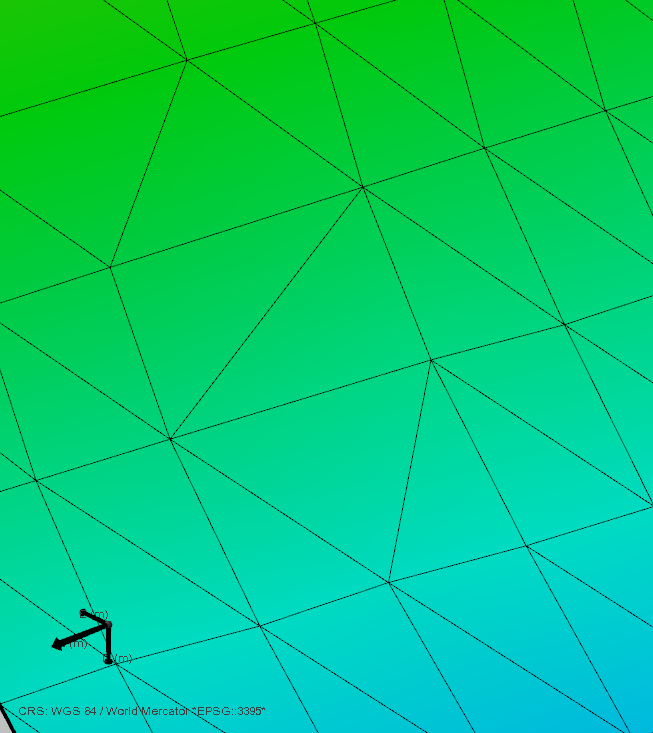
The created hole is then filled with the Fill Hole tool. click to enlarge